Saturday, April 30, 2011
Bruce Schneier: The security mirage
"If it's in a newspaper don't worry about it" is definitely a great line.

Friday, April 29, 2011
Property Taxes Are For Parasites: Billionaires Use The “Fake Farm Loophole” To Not Pay Any…
http://exiledonline.com/property-taxes-are-for-parasites-billionaires-use-the-fake-farm-loophole-to-not-pay-any/
Many states expanded the definition of “agricultural land” beyond land that was farmed to land that simply had not yet been developed. In South Carolina, all it takes is five acres of trees to qualify for a tax exemption. New Jersey requires that a landowner have five acres, but also sell $500 of agricultural goods a year from their farm. Steve Forbes and his wife, Sabrina, qualify for their exemption by breeding show cows on their 450-acre Bedminster estate. “You don’t make money selling hamburger meat. You make money breeding show cows; that’s the name of the game,” Forbes told Fortune magazine in 1996. Florida requires a couple of cows or a herd of goats, which don’t have to be on the property all the time. Texan law is so broadly defined that the PGA Tour golf resort in San Antonio has been trying get recognized as a “nature preserve” to get a farm tax break.
Thursday, April 28, 2011
US Deficit Spending Update
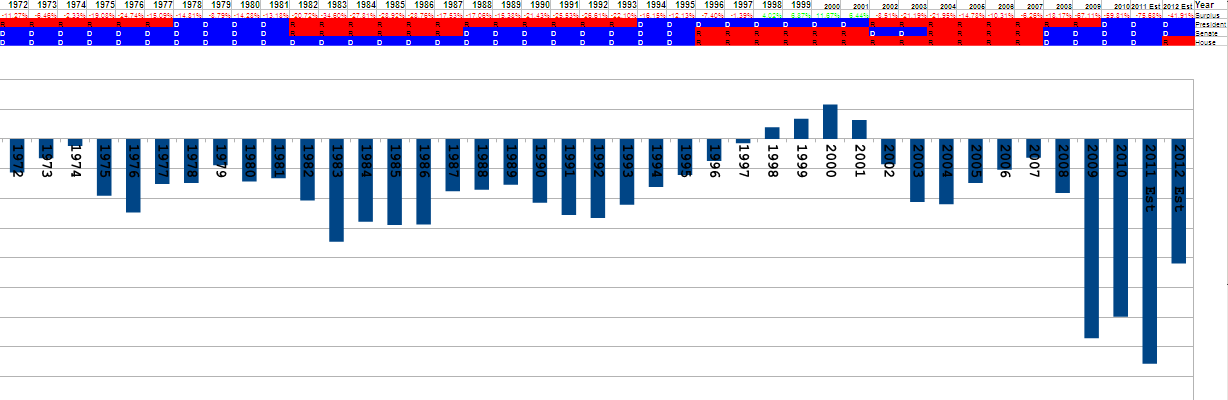
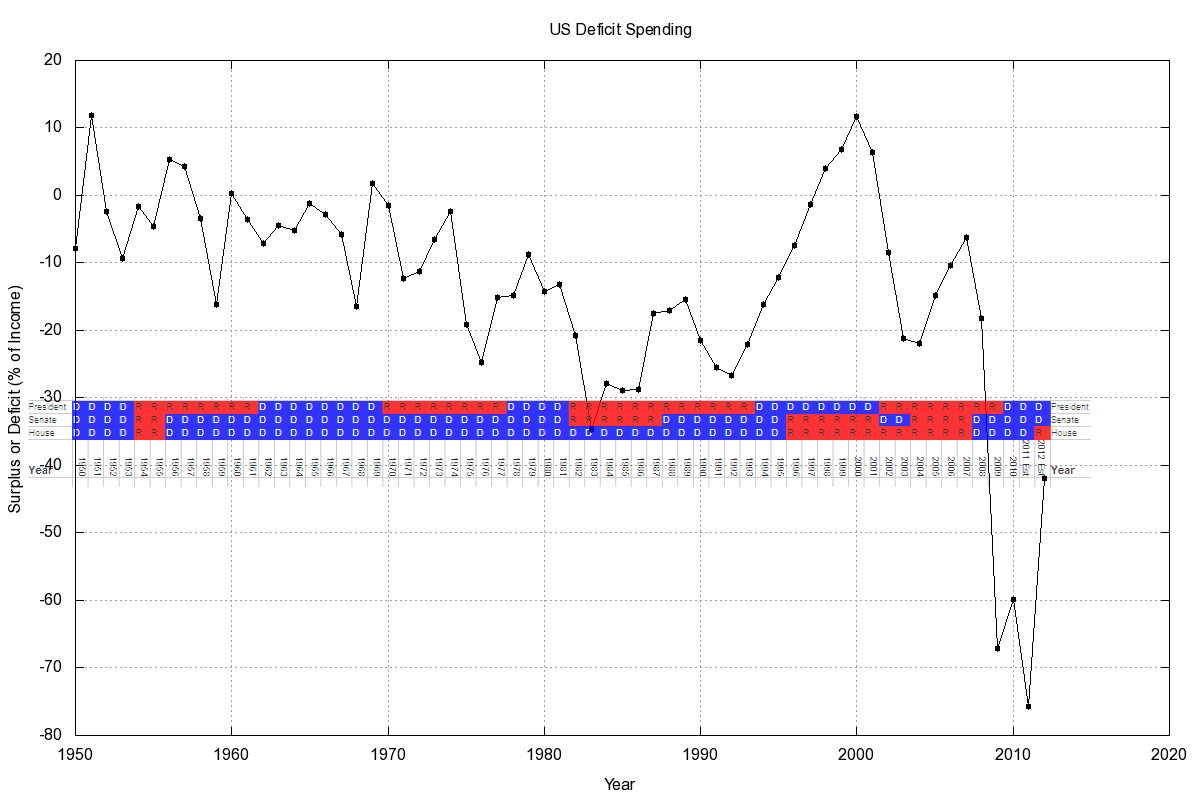
I'm sure you all remember my famous post about political parties and spending from late 2009. I wanted to update it with whatever additional data was available. I mentioned before that I had found a nice spreadsheet with all the data but lost it, and couldn't find it again. The good news is that I found that spreadsheet again. The bad news is that the data didn't match. Further inspection revealed that the data prior to 2004 did match, but that the 2004 and later data didn't. I checked the 2003 spreadsheet and, sure enough, the numbers I had for 2004 and later were the 2003 estimates. My fatal mistake was in using data from some random website as opposed to the GPO website. This was because I was too lazy to get the data from a bunch of individual spreadsheets. Who ever could have guessed my laziness would come back to haunt me?
My previous spreadsheet showed FY2009 as having a 9% deficit (i.e. we spent 9% more than we took in). In reality it was 67%. As you might guess, that's the worst it's been since WWII.
As far as the new data goes, there are some interesting things to note. First is that the actual numbers were better than the estimates (up to 2008). In 2007 the deficit was 6.3%. Looking at the change in revenue and spending in 2008 and 2009 makes it clear how it went from 6.3% to 67% in two years. There was a 9% and 18% increase in spending for those two years (average being about 6%). This was coupled with a 2% and then a 17% reduction in income. The other interesting thing is that 2010 saw a 1.75% reduction in spending from 2009. That is the first time the Federal government spent less money than a previous year since 1965.
2010 is the newest data available (FY2011 ends in sept 2011). I've included the 2011 and 2012 estimates (labeled this time).
The (updated) data is here:
http://daleswanon.org/blog/deficits.png
http://daleswanon.org/blog/deficits2.png
http://daleswanon.org/blog/deficits.pdf
http://daleswanon.org/blog/deficits.ods
Sunday, April 24, 2011
Is the United States a democracy or a republic?
This question is a favorite of online political discussions (truly the purest form of civil debate). When someone brings it up, their point is usually that the US is not a "true democracy" but rather a watered down form called a republic. Often, they will cite the fact that we do not directly vote on laws, but rather elect representatives who then vote on our behave. In the end, this is all hogwash as the United States is both a democracy and a republic. The question of democracy vs republic is analogous to asking if something is bright or yellow, i.e., both are independent qualities.
What is a republic?
The word republic derives from the Latin phrase res publica, which means "public matter". The term was invented by the Romans to describe their form of government between the period of rule by kings and rule by emperors (many emperors still used the term to describe their rule, but that doesn't make it true). A republic is a system of government where the head of state is both limited in power by laws, and elected by people. In practice, this means any state that isn't a monarchy or dictatorship is a republic.
What is a democracy?
The word democracy derives from the Greek word demokratía, or "rule of the people". In a democracy the people hold the power to rule. In practice, this means any state where the people are ultimately responsible for writing laws is a democracy.
Athenian democracy
It is true that these definitions I have given are different from the original classical definitions. This is, I think, the point many people are trying to make when they claim the US isn't a democracy. They are insisting that they would prefer a system of direct or pure democracy where people create and vote on laws directly without any representative body (e.g. Congress). This is all well and good, but to present the issue of one of either democracy or republic is misleading. A government can have both, neither, or either one. It is also probably worth noting that in the original Athenian democracy form, only 1 in 10 people could vote. If by virtue of being the original, this definition has more weight, then consider me quite glad we do not have a democracy.
Direct democracy
In modern usage, democracy has come to mean a system where people have a voice in the creation of laws. Either directly, as in direct democracy, or indirectly, as in representative democracy. There are examples of modern direct democracies, where (nearly) all the people of a state vote, with equal say, on laws.
Is direct democracy better than representative democracy?
One thing is certain, it is more popular. People like the idea of having power, and they like the idea of having control over themselves. I would support adding direct democracy elements (not the total removal of Congress). However, I am unswayed as to the superiority of direct democracy vs representative democracy. In the US many states have ballot initiatives, which are pretty close to direct democracy. Yet, those states don't differ very much from states without those initiatives. At the end of the day, our representatives do a pretty good job of accurately representing us. Or at least at representing what we care about enough to actually go vote about. Note, I am not saying they do a good job at representing our best interests (not by a long shot). Rather, they know what issues people care strongly enough to actually go vote about, i.e., big, flashy, popular issues that often have very little actual meaning.
People have a tendency to feel as if majority rule is the fairest system. However, it has many well known flaws. The core of the problem is that 51% of the people should not be able to impose their will upon 49%. On the other hand, the majority should have its way in many matters, but the more serious a matter is the more important it is to limit the majorities power. To use the extreme example: A group that is a majority shouldn't be allowed to vote to enslave a minority group. There is a quote that summarizes this well, "Democracy is two wolves and a lamb voting on what to have for lunch".
Tuesday, April 19, 2011
Thursday, April 14, 2011
Predator Outdoes Kinect At Object Recognition
http://news.slashdot.org/story/11/04/14/1814238/Predator-Outdoes-Kinect-At-Object-Recognition
"A real breakthough in AI allows a simple video camera and almost any machine to track objects in its view. All you have to do is draw a box around the object you want to track and the software learns what it looks like at different angles and under different lighting conditions as it tracks it. This means no training phase — you show it the object and it tracks it. And it seems to work really well!The video is very impressive.
The really good news is that the software has been released as open source so we can all try it out! This is how AI should work."
Monday, April 11, 2011
Mars for Less
http://en.wikipedia.org/wiki/Mars_for_Less
The Mars for Less mission is heavily based on Robert Zubrin's Mars Direct mission design, in which two different spacecraft are used for a single human expedition. One spacecraft (called the Earth Return Vehicle, or ERV) is sent to Mars unmanned on a trajectory similar to a Hohmann Transfer Orbit before the crew. This vehicle lands and fuels itself using a Sabatier process, creating methane/oxygen rocket fuel (bipropellant) out of carbon dioxide obtained from the Martian atmosphere and a relatively small amount of hydrogen imported from Earth. Once the ERV is fuelled, the crew is launched to Mars on a free return trajectory. The crew arrives after about 180 days and lands in the proximity of the ERV. They spend about 500 days on the surface exploring, then return to Earth in the ERV.
The Mars for Less plan is different from Mars Direct in that it uses multiple launches of existing launch vehicles, instead of a few launches of heavy lift boosters. In the MFL plan, separate components are launched individually to low-Earth orbit, where they are mated together over the course of about half a year. Each component is itself autonomous, so that only an orbital assembly, and not construction, would ideally be required. By avoiding the development of a heavy lift launch vehicle like NASA's proposed Ares V, such a mission could theoretically be undertaken today.
Life expectancy in the 1800s not as bad as reported
http://gcanyon.wordpress.com/2009/06/25/life-expectancy-in-the-1800s-not-as-bad-as-reported/
Comparing just life expectancy for 20 year-olds, in 1850 a young man could expect to live to 60.1. In 2004, that same man could expect to live to 76.7. That’s a significant improvement, but considering that in 1850 the germ theory of disease was just being formalized, it seems a little less impressive.
Thursday, April 7, 2011
Copyrights
Since I'm very vain, I regularly check the stats for this blog. The most popular landing page is the Wawa locations post. It is followed closely by the various essays for school that I posted here. Today, I noticed that someone came into my essay on service learning by searching for the first line. I know this is standard practice to see if something is copied from elsewhere. I wondered if my paper had appeared somewhere else and someone was searching for the original. Sure enough, that same Google search shows my blog as well as another site with my paper. That site gives a few paragraph sample and is selling it for $15. I'm not sure how I feel about it receiving a rating of only 4 out of 7 or "Stronger Essays". Although, in my defense, that essay was written under a time limit. I was a bit disappointed they only stole that one essay and not my term paper, which I feel was better written. I guess service learning is a more popular topic among plagiarizing college students students wishing to "learn by seeing a well-written example".
I thought briefly about contacting them and telling them to take it down, but A I don't think they'd listen, B I'm too lazy to care and C it's somewhat comforting that many people will find the essay on that site but just get it for free from my blog. That being said, let me be clear that I don't consent to it being there, to preserve my legal right to sue them when they make it so that you can file lawsuits without ever putting on pants. If I use the RIAA's method of calculating damages, and since those first few paragraphs are just as copyrighted as the rest, they owe me $150,000 for each page view.
Tuesday, April 5, 2011
Pass the Plutonium
http://spectator.org/archives/2011/04/01/pass-the-plutonium
Another hot button has been plutonium, an artificial element formed in a reactor. (Plutonium is forged in supernovas, along with all the other heavy elements, but it disappeared on earth long ago.) In the effort to portray nuclear power as the devil's handiwork, Ralph Nader once labeled plutonium "the most toxic substance ever known to mankind." In fact it is about as toxic as caffeine. Bernard Cohen, the tireless crusader for nuclear common sense, offered many times to eat as much plutonium as Nader would eat caffeine on "The Tonight Show" but Nader never took him up.
Subscribe to:
Posts (Atom)