Life on a cubic Earth would be pretty different. Although gravity on the surface wouldn’t generally point toward the exact center of the Earth anymore (that’ a symptom of being a sphere), it will still point roughly in toward the center. So, the closer you are to an edge, the more gravity will make it feel as though you’re on a slope. So, although it won’t look like it, it will feel like each of the six sides forms a bowl. This has some very profound effects.
Saturday, May 21, 2011
Q: What would Earth be like to us if it were a cube instead of spherical? Is this even possible?
http://www.askamathematician.com/?p=6657

Sunday, May 15, 2011
FCC Commissioner Leaves To Become Lobbyist
http://yro.slashdot.org/story/11/05/11/2156237/FCC-Commissioner-Leaves-To-Become-Lobbyist
"Meredith Attwell Baker, one of the FCC Commissioners, is leaving the FCC to become a lobbyist for Comcast-NBC, just four months after approving their merger deal. She refused to put any significant conditions on the merger, saying that the deal would 'bring exciting benefits to consumers that outweigh potential harms.' Comcast has released an official statement saying that, 'Meredith's executive branch and business experience along with her exceptional relationships in Washington bring Comcast and NBCUniversal the perfect combination of skills.'"
Monday, May 9, 2011
Battle Brews Over FBI's Warrantless GPS Tracking
http://yro.slashdot.org/story/11/05/09/1415258/Battle-Brews-Over-FBIs-Warrantless-GPS-Tracking
"The FBI's use of GPS vehicle tracking devices is becoming a contentious privacy issue in the courts, with the Obama administration seeking Supreme Court approval for its use of the devices without a warrant, and a federal civil rights lawsuit targeting the Justice Department for tracking the movements of an Arab-American student. In the midst of this legal controversy, Threat Level decided to take a look at the inside of one of the devices, with the help of the teardown artists at iFixit."
Monday, May 2, 2011
Sunday, May 1, 2011
What is the GPL?
Intro
The GNU General Public License (GPL) is a license used for open source software. Open source software is simply software which makes the source code (or blueprints) available along with the version that people actually run on their computers. This allows others to edit and improve the software, as well as verify that it doesn't do anything malicious. The current version of the GPL is about 5200 words or 31,000 characters. This may seem very verbose for something that seems rather simple. Indeed, many may question why one would even need a license if they were simply giving the source code away with their software. The answer is that the GPL does a lot more than simply give away the source code.
What does the GPL do?
Recently there was a discussion on Slashdot about the GPL. Slashdot is generally very in favor of the GPL. A few users were going against the grain and commenting on how the GPL was actually virus like. Their point was that any code that became infected with GPL code became GPL code itself, and it was difficult to clean the GPL code out. The replies were that this is the very purpose of the GPL. The GPL essentially says that anyone may use the source code, however they must always make the full source code available with the program. Any changes to the source code are automatically covered by the GPL and must also be made available. The addition of a small piece of GPL code to a very large program makes that entire program GPL'd and the entire source must be released.
How does GPL do this?
Some might see this as unfair. What right does this GPL have to force me to release the source code to software I wrote? The answer is none, unless one agrees to it. How does one agree to it? By using code that is covered by it.
Copyright Review
In just about any country today copyright is automatically applied to anything anyone writes. For example, this blog post is copyrighted by me, despite bearing no formal copyright notice, and despite me not registering it. No one may use this post in anyway without my consent. My consent could be as simple as "you can use it any way you want", or it could be much more complex, with many conditions. In that case, it is called a license. I may come up with whatever conditions I want for you to use this post. Perhaps, I say you can only repost it on Tuesdays, or if you are located in Houston, TX. Note these restrictions don't apply to me, since I "own" the content. I can require you be in Houston to repost it, while I myself am not in Houston. The key is that you are free to not use my work, so you can't argue that my terms are unreasonable or silly.
Another important point is that if you take this post and change it in some way and then republish it, that is called a "derivative work". You may only make derivative works if I consent, and I may place whatever restrictions I wish on the derivative works (however they must be made clear prior to our agreement). A common example might be the requirement that you don't sell the derivative work, i.e., you make it freely available. Or, I may require you to pay me some fee for each copy you do sell. Again, I can come up with whatever restrictions I want, and you can choose to agree to them and make the derivative work, or not agree and not use my work.
Those are the principles the GPL uses to accomplish its job. If someone wants to use code that is covered by the GPL, they are free to do so. However, they are agreeing to a license that says they will then make all derivative works also freely available and covered by the GPL.
BSD License
For software, the main alternative to the GPL is the BSD license. The BSD license is much simpler and can be generalized as saying that anyone can do anything they want with the code as long as they attribute the original author. This is often called a freer license, and strictly speaking, it does place less restrictions, and is thus more free. That being said, the BSD license will allow someone to make changes to software and then keep those changes secret. This is a benefit to the person making changes but hurts the end users who no longer have access to the source code. It is often said that BSD license is more free for programmers and less free for users.
Creative Commons
Creative commons are a recent addition to the family of sharing licenses. While the GPL and BSD license are specifically tailored for software, CC licenses are used more generally by anything covered by copyright (websites, music, video, pictures, etc.). It is perhaps most well known as the license used by Wikipedia. CC offers greater flexibility, and licenses similar to both the GPL and BSD license can be created using it. There are four main conditions which the author can choose to use or not, each with a two letter abbreviation. Attribution (by) requires that one must attribute the original author when one redistributes the work. While technically optional, all the common licenses have the (by) restriction. Noncommercial (nc) requires that one may not sell the work or derivative works. No Derivative Works (nd) means that one may not change the work in any way. Share-alike (sa) means one may only redistribute using an identical license. This gives a similar "virus like" nature to the GPL. There are 16 combinations of those 4 restrictions. However, some can't be used together (e.g. (nd) and (sa) make no sense) and, according to Wikipedia, 98% of licenses use (by). With that in mind, there are six commonly used licenses combinations, which can be reviewed in greater detail on the CC site.
Saturday, April 30, 2011
Bruce Schneier: The security mirage
"If it's in a newspaper don't worry about it" is definitely a great line.
Friday, April 29, 2011
Property Taxes Are For Parasites: Billionaires Use The “Fake Farm Loophole” To Not Pay Any…
http://exiledonline.com/property-taxes-are-for-parasites-billionaires-use-the-fake-farm-loophole-to-not-pay-any/
Many states expanded the definition of “agricultural land” beyond land that was farmed to land that simply had not yet been developed. In South Carolina, all it takes is five acres of trees to qualify for a tax exemption. New Jersey requires that a landowner have five acres, but also sell $500 of agricultural goods a year from their farm. Steve Forbes and his wife, Sabrina, qualify for their exemption by breeding show cows on their 450-acre Bedminster estate. “You don’t make money selling hamburger meat. You make money breeding show cows; that’s the name of the game,” Forbes told Fortune magazine in 1996. Florida requires a couple of cows or a herd of goats, which don’t have to be on the property all the time. Texan law is so broadly defined that the PGA Tour golf resort in San Antonio has been trying get recognized as a “nature preserve” to get a farm tax break.
Thursday, April 28, 2011
US Deficit Spending Update
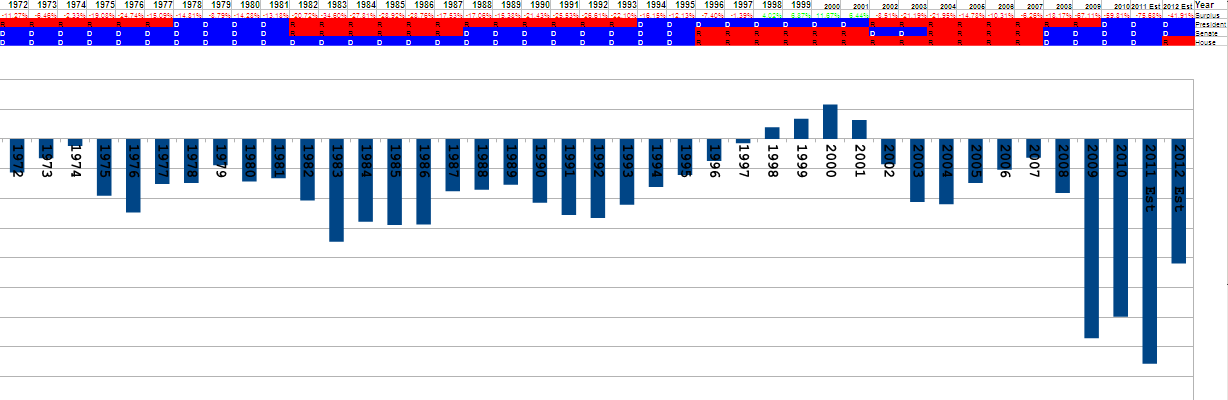
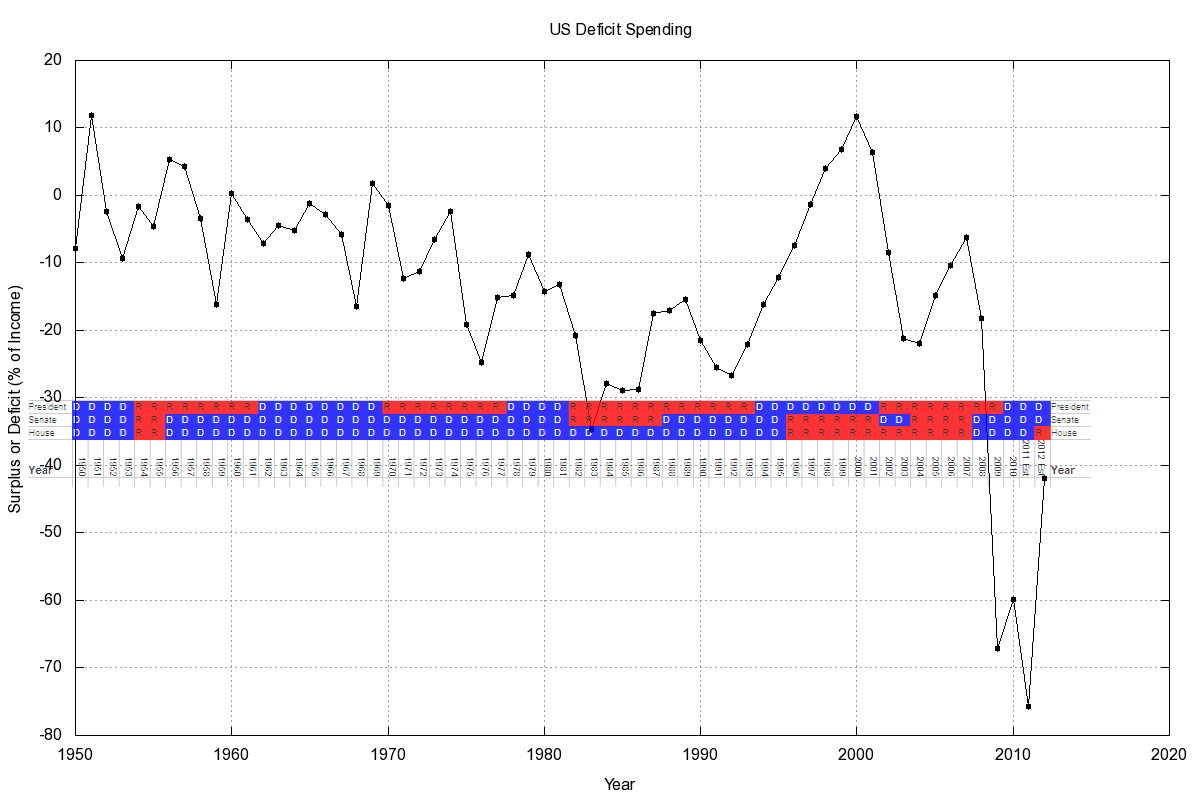
I'm sure you all remember my famous post about political parties and spending from late 2009. I wanted to update it with whatever additional data was available. I mentioned before that I had found a nice spreadsheet with all the data but lost it, and couldn't find it again. The good news is that I found that spreadsheet again. The bad news is that the data didn't match. Further inspection revealed that the data prior to 2004 did match, but that the 2004 and later data didn't. I checked the 2003 spreadsheet and, sure enough, the numbers I had for 2004 and later were the 2003 estimates. My fatal mistake was in using data from some random website as opposed to the GPO website. This was because I was too lazy to get the data from a bunch of individual spreadsheets. Who ever could have guessed my laziness would come back to haunt me?
My previous spreadsheet showed FY2009 as having a 9% deficit (i.e. we spent 9% more than we took in). In reality it was 67%. As you might guess, that's the worst it's been since WWII.
As far as the new data goes, there are some interesting things to note. First is that the actual numbers were better than the estimates (up to 2008). In 2007 the deficit was 6.3%. Looking at the change in revenue and spending in 2008 and 2009 makes it clear how it went from 6.3% to 67% in two years. There was a 9% and 18% increase in spending for those two years (average being about 6%). This was coupled with a 2% and then a 17% reduction in income. The other interesting thing is that 2010 saw a 1.75% reduction in spending from 2009. That is the first time the Federal government spent less money than a previous year since 1965.
2010 is the newest data available (FY2011 ends in sept 2011). I've included the 2011 and 2012 estimates (labeled this time).
The (updated) data is here:
http://daleswanon.org/blog/deficits.png
http://daleswanon.org/blog/deficits2.png
http://daleswanon.org/blog/deficits.pdf
http://daleswanon.org/blog/deficits.ods
Sunday, April 24, 2011
Is the United States a democracy or a republic?
This question is a favorite of online political discussions (truly the purest form of civil debate). When someone brings it up, their point is usually that the US is not a "true democracy" but rather a watered down form called a republic. Often, they will cite the fact that we do not directly vote on laws, but rather elect representatives who then vote on our behave. In the end, this is all hogwash as the United States is both a democracy and a republic. The question of democracy vs republic is analogous to asking if something is bright or yellow, i.e., both are independent qualities.
What is a republic?
The word republic derives from the Latin phrase res publica, which means "public matter". The term was invented by the Romans to describe their form of government between the period of rule by kings and rule by emperors (many emperors still used the term to describe their rule, but that doesn't make it true). A republic is a system of government where the head of state is both limited in power by laws, and elected by people. In practice, this means any state that isn't a monarchy or dictatorship is a republic.
What is a democracy?
The word democracy derives from the Greek word demokratía, or "rule of the people". In a democracy the people hold the power to rule. In practice, this means any state where the people are ultimately responsible for writing laws is a democracy.
Athenian democracy
It is true that these definitions I have given are different from the original classical definitions. This is, I think, the point many people are trying to make when they claim the US isn't a democracy. They are insisting that they would prefer a system of direct or pure democracy where people create and vote on laws directly without any representative body (e.g. Congress). This is all well and good, but to present the issue of one of either democracy or republic is misleading. A government can have both, neither, or either one. It is also probably worth noting that in the original Athenian democracy form, only 1 in 10 people could vote. If by virtue of being the original, this definition has more weight, then consider me quite glad we do not have a democracy.
Direct democracy
In modern usage, democracy has come to mean a system where people have a voice in the creation of laws. Either directly, as in direct democracy, or indirectly, as in representative democracy. There are examples of modern direct democracies, where (nearly) all the people of a state vote, with equal say, on laws.
Is direct democracy better than representative democracy?
One thing is certain, it is more popular. People like the idea of having power, and they like the idea of having control over themselves. I would support adding direct democracy elements (not the total removal of Congress). However, I am unswayed as to the superiority of direct democracy vs representative democracy. In the US many states have ballot initiatives, which are pretty close to direct democracy. Yet, those states don't differ very much from states without those initiatives. At the end of the day, our representatives do a pretty good job of accurately representing us. Or at least at representing what we care about enough to actually go vote about. Note, I am not saying they do a good job at representing our best interests (not by a long shot). Rather, they know what issues people care strongly enough to actually go vote about, i.e., big, flashy, popular issues that often have very little actual meaning.
People have a tendency to feel as if majority rule is the fairest system. However, it has many well known flaws. The core of the problem is that 51% of the people should not be able to impose their will upon 49%. On the other hand, the majority should have its way in many matters, but the more serious a matter is the more important it is to limit the majorities power. To use the extreme example: A group that is a majority shouldn't be allowed to vote to enslave a minority group. There is a quote that summarizes this well, "Democracy is two wolves and a lamb voting on what to have for lunch".
Subscribe to:
Posts (Atom)